
₹50,000 a month, every month, without touching a job — that’s the pitch behind using an SWP as passive income. It’s not fantasy. A Systematic Withdrawal Plan really does let you pull a fixed amount out of your mutual fund investment on a schedule while the rest of your money stays invested. But the number that decides whether this works for you isn’t the withdrawal amount — it’s the size of the corpus behind it, and most people get that part backwards.
How SWP As Passive Income Actually Works
An SWP, or Systematic Withdrawal Plan, lets you withdraw a fixed sum from your mutual fund investment at a chosen frequency — usually monthly. Each time a payout is due, the fund house redeems just enough units at the current NAV to cover it. The remaining units stay invested and continue to participate in whatever the market does next.
This is fundamentally different from a fixed deposit, where you earn interest on an untouched principal. With SWP, you’re not earning “income” in the traditional sense — you’re selling a slice of your investment on a schedule. The mutual fund doesn’t pay interest the way a bank deposit does; instead, units are redeemed to generate the cash flow you’ve asked for. That distinction is what makes the next section important.
How Much Corpus You Need For SWP As Passive Income Of ₹50,000 A Month
The amount you can safely withdraw depends on your withdrawal rate — the percentage of your total corpus you take out each year. A lower withdrawal rate tends to help the corpus last longer, while a higher rate raises the risk of running it down faster, especially if returns come in below expectations.
Here’s what that looks like for a target of ₹50,000 a month (₹6 lakh a year):
| Annual Withdrawal Rate | Annual Withdrawal | Approximate Corpus Needed |
|---|---|---|
| 4% | ₹6,00,000 | ₹1.5 crore |
| 5% | ₹6,00,000 | ₹1.2 crore |
| 6% | ₹6,00,000 | ₹1 crore |
A ₹1 crore corpus can potentially support a ₹50,000 monthly withdrawal at around a 6% annual rate, ₹1.2 crore does the same at a 5% rate, and ₹1.5 crore brings the rate down to 4%. These are illustrative figures, not guarantees — actual sustainability depends on returns, volatility, and how long you need the income to last.
SIP To SWP As Passive Income: A Real Worked Example
The cleanest way to see how this plays out is to follow one investor through both phases. Someone who invests a fixed monthly amount through SIP for several years, assuming a steady annual return, builds a corpus through compounding — the same mechanism that makes SIPs attractive in the first place. Once that accumulation phase ends and a fixed monthly SWP begins, the corpus keeps earning returns on whatever’s left after each withdrawal, so the balance can keep growing even while money is being taken out — provided the withdrawal stays smaller than the returns generated.
That last condition is the whole ballgame. If your withdrawal rate sits comfortably below your expected returns, the corpus can hold steady or even grow while you draw income from it. If it doesn’t, you’re slowly liquidating your own investment — which isn’t necessarily wrong, but it’s not the “income without touching capital” story that gets sold.
Live Example:
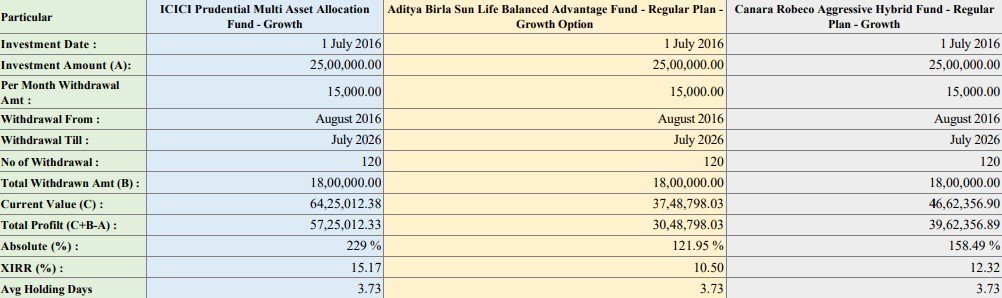
In July 2016, Amit had invested an amount of Rs. 25 Lakhs and wanted a passive income source to fund his monthly expenses of Rs. 15,000. So he started with a monthly withdrawal of Rs. 15,000 from Aug 2016.
The possible scenarios of actual fund returns are given below:
Is SWP As Passive Income Better Than Fixed Deposit Interest?
They solve different problems, so “better” depends on what you value more — certainty or growth potential.
| Factor | SWP | Fixed Deposit |
|---|---|---|
| Income source | Redemption of mutual fund units | Interest payment |
| Market exposure | Returns vary with market performance | Interest rate fixed at opening |
| Growth potential | Equity component can continue to grow | Limited to the agreed interest rate |
| Taxation | Equity: LTCG/STCG rules apply; only the gains portion is taxed | Interest taxed at your income tax slab; TDS above threshold |
| Capital protection | Not guaranteed; corpus can rise or fall | Deposit insurance up to ₹5 lakh per depositor per bank under DICGC |
If you need absolute certainty on a fixed sum every month, an FD ladder still wins. If you can tolerate variability in exchange for inflation-beating growth potential over a longer horizon, SWP as passive income becomes the more efficient tool — particularly because only the gains portion of each withdrawal is taxed, not the entire amount.
“Apni retirement income plan karni hai?” ==> Click Here
Practical Steps To Start SWP As Passive Income
- Decide your target monthly withdrawal and work backwards to the corpus needed at a 4–6% annual rate.
- Split the corpus between debt/conservative-hybrid funds (for near-term withdrawals) and equity-oriented funds (for long-term growth), rather than parking it all in one category.
- Set the SWP frequency to monthly and choose a fixed amount over appreciation-only withdrawal if you need predictable cash flow.
- Review the withdrawal rate against actual fund performance once a year — don’t set it and forget it.
- Use your fund house’s SWP calculator before committing to stress-test the corpus against lower-return scenarios
“The new way of investing in Real estate.” ==> Click Here
FAQs
Is SWP as passive income guaranteed? No. SWP does not provide guaranteed income — withdrawals come from the investment corpus, and market performance can influence how long the portfolio supports withdrawals.
What withdrawal rate makes SWP as passive income sustainable? There’s no universal number, but industry illustrations commonly use 4–6% annually as a reference range, with lower rates giving the corpus a better chance of lasting longer.
Is SWP as passive income taxable? Yes. Only the gains portion of each withdrawal is taxed under capital gains rules (LTCG/STCG depending on the fund type and holding period), not the full withdrawal amount — which is one reason it can be more tax-efficient than FD interest, which is taxed at your slab rate.
Can I stop my SWP as passive income anytime? Yes — an SWP can be stopped anytime by submitting a request to the mutual fund company, with no penalty, and the remaining investment stays with you.
Disclaimer: This content is for educational purposes only and does not constitute personalized financial or insurance advice. Mutual fund investments are subject to market risks, and past performance does not guarantee future returns.
You can connect with us to understand more on how you can generate a regular income stream from mutual fund investments. We are AMFI Registered Mutual Fund & SIF Distributor (ARN-94926).
Connect with us instantly –> Click here
2 thoughts on “SWP As Passive Income: How Much Corpus You Actually Need”